Skip to content

Dog training course

Training guide dogs

Preparing a dog to guide a person with total or partial sight loss, taking their routes and everyday needs into account.

Duration
9–12 months
Dog selection
School puppies
Training
From an early age
Owner
Training included

The school selects and raises puppies specifically to become guide dogs. This is a dedicated selection and support programme, rather than an ordinary course for your own dog.

Assessing your needs comes first

The school selects and raises puppies specifically to become guide dogs. This is a dedicated selection and support programme, rather than an ordinary course for your own dog.

We confirm class availability, teaching language, venue and timetable for your city. A translated website does not mean that a local branch is available.

About the course

Guidance built around the person.

For people who are blind or have severe visual impairments. The programme includes training for the future owner.

The training approach

Selection and initial training

The purpose of training and the dog's suitability for the task are established.

Role-specific skills

The content and sequence depend on the discipline and the dog's readiness.

Working with the handler

Handling and joint practice form part of training the partnership.

Final assessment

The examination or assessment requirements are discussed before training begins.

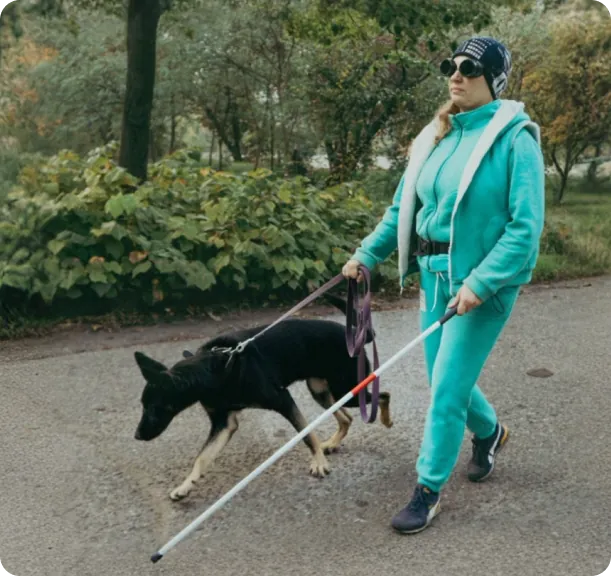
Practising mobility with a dog and a white cane.

Course content

Course syllabus

The training content is outlined by subject. Arrangements and the sequence of work are discussed with the instructor.

Ask about the syllabus
01Guiding along a route

The dog guides a blind person along their chosen route, taking junctions and potential obstacles into account.

02Stopping before obstacles

Stops at kerbs, steps and other obstacles, alerting the owner to danger.

03Finding important features

Helps find doors, benches, service counters, pedestrian crossings and other features of the urban environment.

04Resilience to noise and stress

Accustomed to traffic, loud sounds and challenging environments, the dog remains calm and focused.

05A calm temperament

Consistently composed, focused on the owner and ready to work together in any situation.

06Managing potential risks

The dog will not follow a command that puts the owner at risk, and will choose a safe course of action.

Completing training

Assessment before handover to the owner

The assessment checks route guidance, stopping before obstacles, finding features, assessing risks and calm behaviour in an urban environment.

Training experiences

Dog training reviews

Experiences from clients on different school programmes. All dog training reviews

Leave a review
Leave a review of the school

Your training experience

Tell us about the sessions and your work with the instructor.

Before your first session

Questions and answers

Training, owner participation and course terms.

How does the NSHSS guide dog training course differ from programmes offered by other schools and private specialists?
There are currently only a limited number of organisations in Europe that provide guide dog training meeting the requirements for fully supporting a person with a visual impairment in everyday life. Most advertised programmes and specialists focus on demonstration training, aimed at performing exercises at showcases or competitions. Such approaches do not give a dog the practical skills a blind person needs for daily navigation in urban and social environments. NSHSS is one of the few schools providing the complete training cycle: from the selective breeding and selection of puppies and their early socialisation to specialist training that takes international guide dog standards and requirements into account. The programme produces a dog ready to act as a guide in real-life conditions, showing resilience to stress, the ability to make independent decisions in critical situations and the capacity to support the owner's safety, mobility and social integration.
Is the Guide Dog course suitable for partial sight loss, or only for people who are completely blind?
The course is designed for both people who are completely blind and those with severe visual impairments. The programme is adapted to the owner's specific needs.
How long does guide dog training take?
Full training takes 9 to 12 months. This time is needed to consolidate the complete set of skills until they become automatic.
Can an adult dog be trained, or does NSHSS select the dogs itself?
We select puppies from our own kennels and raise them specifically for guide work. This guarantees a stable temperament and suitable character.
How will I know that the dog can really guide and protect me?
Before being handed over to the owner, the dog completes a final assessment demonstrating all its skills: route guidance, stopping before obstacles, finding features, managing potential risks and remaining calm in an urban environment.
What if I have never had a dog before?
The course includes training for both the dog and the owner. Instructors will show you how to work with your guide dog to build full mutual understanding.

What happens after you contact us

Getting to know you

You tell us about your dog, city, previous experience and needs.

Finding the right fit

We discuss a suitable programme, format, instructor and available timetable.

Your decision

You confirm the fees and terms, then decide whether the training is right for you.

Request a consultation

An enquiry helps clarify the terms. It is neither a payment nor confirmation of a place in a group.

Get in touch

Let's discuss your needs

Leave your contact details and we will get back to you.