Skip to content

Dog training course

Protection and Guard Training

Preparing a dog to protect its owner and property. Protection skills, staying in position and reliable handling under an instructor's guidance.

Duration
3 months
Dog's age
From 9 months
Sessions
3 times a week
Format
Individual sessions

Suitability is discussed in light of the dog's working qualities, foundation training and living conditions. If the foundations are missing, training takes additional time.

Assessing your needs comes first

Suitability is discussed in light of the dog's working qualities, foundation training and living conditions. If the foundations are missing, training takes additional time.

We confirm class availability, teaching language, venue and timetable for your city. A translated website does not mean that a local branch is available.

About the course

Protection skills and control.

For owners who need to prepare their dog for protection work. Dogs older than 3–4 years require an initial assessment by a dog trainer.

The training approach

Selection and initial training

The purpose of training and the dog's suitability for the task are established.

Role-specific skills

The content and sequence depend on the discipline and the dog's readiness.

Working with the handler

Handling and joint practice form part of training the partnership.

Final assessment

The examination or assessment requirements are discussed before training begins.

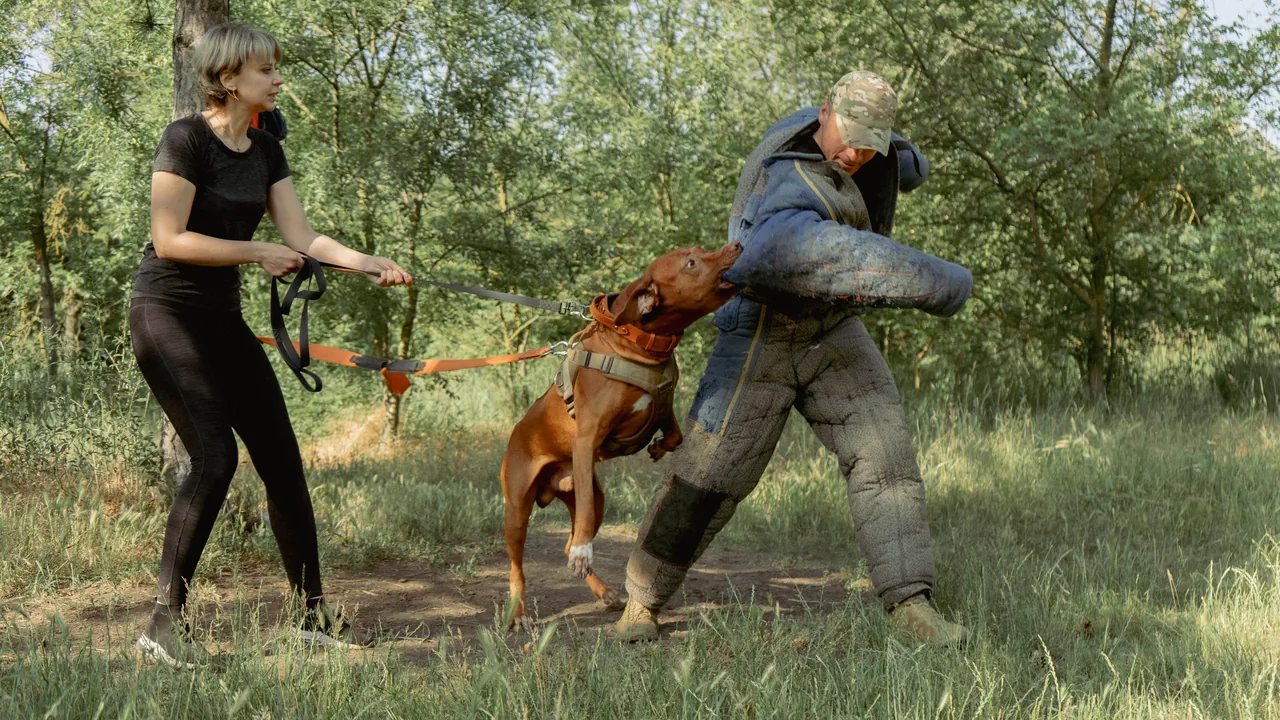
Protection exercise: a female handler holds the dog on leads while a decoy works with a protective sleeve

Course content

Course syllabus

The training content is outlined by subject. Arrangements and the sequence of work are discussed with the instructor.

Ask about the syllabus
01Guarding an object

The dog lies off the lead with an object in front of it, and the owner gives the command ‘Guard’. The dog must not leave its position. If an intruder attempts to take the object, the dog signals that it is ready to attack. If the attempt continues, it attacks the intruder and immediately returns to the object. The dog can guard an object against one or several intruders.

02Protecting the owner

The dog protects its owner. It can respond to the owner's command to defend them and can also independently recognise a life-threatening situation and repel an attacker to save its owner.

03Apprehending a fleeing intruder

If an intruder flees, the dog pursues them on the owner's command ‘Stranger’ or ‘Attack’.

04Frontal attack

The dog's ability to repel an intruder attempting to attack it or its owner with an object.

05Remaining calm around gunfire

An assistant fires a shot from a distance of 50 metres. The dog responds calmly.

06Attacking a shooter

The dog fearlessly attacks the opponent's arm despite their attempt to fire a shot. Even if a shot is fired, the dog continues its attack.

07Escorting a detained intruder

The dog escorts the intruder to law enforcement officers, preventing escape. If the intruder attempts to escape, the dog attacks them.

08Scent discrimination of objects

The dog can identify the scent of a target object among other objects, finding the required item or one belonging to its owner.

09Guarding a home

The dog guards a property or building: it reacts to strangers appearing at the entrance door, gate or fence, gives a warning and, if necessary, moves to active protection. It can hold an intruder until the owner arrives or gives the command ‘Release’. Training takes place both indoors and outdoors, developing a clear understanding of the boundaries to be guarded.

Completing training

Final examination

The owner and dog take the examination together. On passing, a school certificate confirming completion of protection and guarding training is issued in the dog's name.

The owner's work between sessions

Progress depends on existing skills, the dog's condition and regular practice by the owner. A skill learnt at the training ground needs to be gradually applied to everyday situations.

Training experiences

Dog training reviews

Experiences from clients on different school programmes. All dog training reviews

Leave a review
Leave a review of the school

Your training experience

Tell us about the sessions and your work with the instructor.

Before your first session

Questions and answers

Training, owner participation and course terms.

Is prior training in basic obedience required for the course?
No, prior training is not required. We have developed a comprehensive programme that incorporates all the key elements of basic obedience directly into the learning process. If your dog has not been trained before, you can work intensively to learn all the necessary skills and achieve the course goals. Please note that in this case the course will be extended by one month to allow full mastery of the foundations.
Is this course suitable for an ordinary pet dog rather than a service dog?
Yes. We train dogs of all breeds from 9 months of age. Even a small dog can perform protective tasks and become a significant deterrent.
My dog is not naturally aggressive. Can it become a protection dog?
Yes. Aggression is not needed. On the course, we teach the dog to act on command and in real situations, rather than to be uncontrollably hostile.
Is it true that a dog becomes aggressive and dangerous after the course?
No. On the contrary, the dog becomes perfectly obedient, more restrained, confident and easier for its owner to control. Learning protection skills develops self-control and a clear understanding of when to act.
Is training a dog for protection safe for others?
Absolutely. The dog acts only on its owner's command and retains a stable temperament. We eliminate situations involving uncontrolled aggression.
Can a dog older than 3–4 years be trained for protection?
However, the ideal starting age is between 9 months and 3 years. In some cases, older dogs can also be trained, but only after an initial assessment by a dog trainer.
What does this course offer the owner?
You gain both a well-behaved dog and a reliable protector capable of acting in critical situations to keep your family and property safe.

What happens after you contact us

Getting to know you

You tell us about your dog, city, previous experience and needs.

Finding the right fit

We discuss a suitable programme, format, instructor and available timetable.

Your decision

You confirm the fees and terms, then decide whether the training is right for you.

Enrol on the course

An enquiry helps clarify the terms. It is neither a payment nor confirmation of a place in a group.

I would like to ask a question first

Request a consultation

Tell us your city and what you need. We will help clarify the programme, format and fees.

Get in touch

Let's discuss your needs

Leave your contact details and we will get back to you.